


(Until Home Becomes a Cage)
If you’re caring for an aging parent, you’ve probably heard this phrase more times than you can count:
“There’s just no place like home.”
Sometimes it’s said warmly.
Sometimes defensively.
And sometimes with a kind of quiet fear underneath it.
And yes, home can absolutely be comforting.
Familiar.
Predictable.
Wrapped in memories like a well-worn blanket.
But here’s the part we don’t say out loud often enough:
Home can also become incredibly isolating.
And while that may sound comforting on the surface, it can slowly become limiting in ways families don’t recognize until much later.
When Comfort Quietly Turns Into Confinement
What makes this so difficult is that it rarely happens all at once.
No one wakes up one morning and says:
“I think I’ll stop living my life.”
Instead, the world slowly starts shrinking.
First it’s:
“I don’t feel like driving at night.”
Then:
“Restaurants are too loud.”
Then:
“I’d rather just stay home today.”
And eventually…
Home becomes easier than effort.
Predictable feels safer than possibility.
And routines slowly replace experiences.
To the outside world, it may not look alarming.
But over time, isolation has a way of disguising itself as comfort.
When “Home” Stops Being Safe
Research continues to show that when older adults become homebound—even temporarily—the risk of functional decline increases significantly.
In simple terms: when people stop engaging with the outside world, their bodies and brains often begin declining alongside it.
And the hardest part?
They don’t always realize it’s happening.
Marla’s World Became Smaller Without Anyone Noticing
I think about Marla often when I have these conversations.
During one of our visits, she said for the third time:
“There’s just no place like home.”
So instead of arguing with her, we talked about her home.
Her memories.
Her stories.
The tornado that nearly took her house down. (Yes, that was terrifying.)
She lit up.
But here’s the truth:
Marla had reached a point where she never left her home.
Not occasionally. Not “just lately.” Never.
Not occasionally.
Not “just lately.”
Permanently smaller.
She had visitors.
She had family support.
She was not neglected.
But despite all of that, her world had become confined.
Not by locks or lack of love.
Partly by fear.
Partly by habit.
And partly by a changing brain that convinced her home was the only safe option.
This is far more common than most families realize.
Why Families Miss This
And families often struggle with this because the situation can feel confusing from the outside.
After all, if someone is home…
and they’re fed…
and people are checking in…
it doesn’t necessarily look like a problem.
But quality of life is about more than physical safety.
Humans need:
- stimulation
- movement
- novelty
- purpose
- connection
And when those things slowly disappear, people often begin adapting to a smaller and smaller version of life without realizing it.
That’s the part that’s so easy to miss.
The Myth We Need to Let Go Of
Home may be where the heart is.
But it is not the only place life can still happen.
The beautiful thing about memories is that they travel with us.
They are not tied to a couch, a kitchen, or a front porch.
In fact, studies show that older adults who go outside regularly often report:
- fewer health complaints
- better sleep
- improved mood
- and less functional decline over time
Movement matters.
Fresh air matters.
Connection matters.
Safety and Living Are Not the Same Thing
However, here is what many families don’t realize:
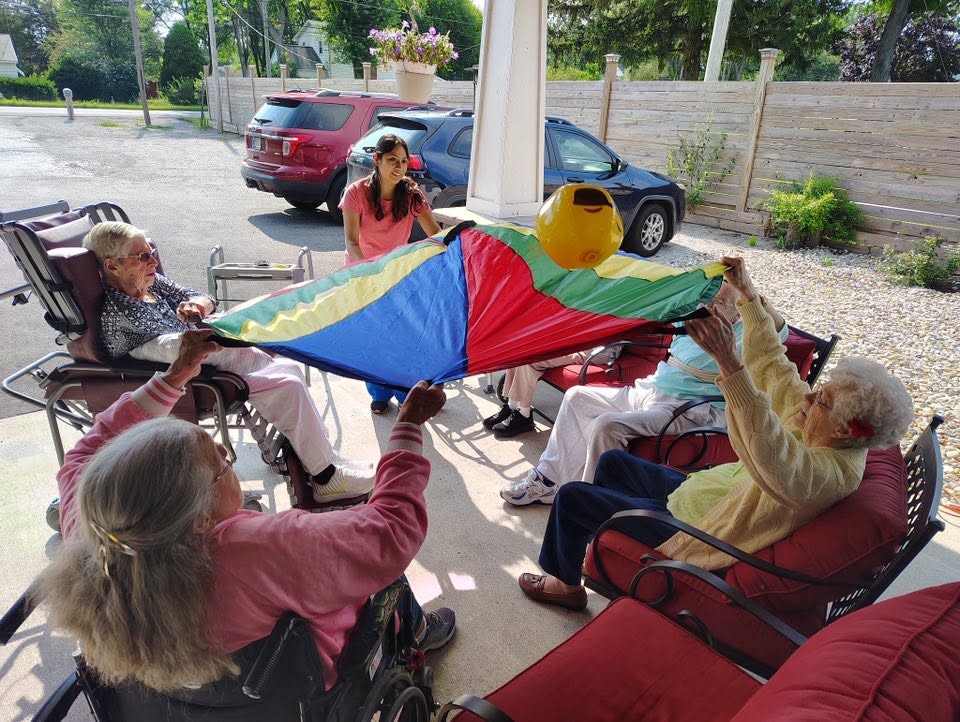
Many senior communities do have outdoor spaces, social opportunities, and activities available.
But if someone cannot access those things independently—or doesn’t think to ask for help—they often go unused.
Being confined to a unit, a routine, or activities chosen for convenience rather than meaning may keep someone safe…
But it doesn’t always help them feel alive.
And humans are not designed merely to exist.
The Goal Isn’t Force—It’s Expansion
And to be clear…
This isn’t about forcing someone into constant activity or pretending aging isn’t difficult.
Some days are exhausting.
Some fears are real.
Some changes are heartbreaking.
The goal is not perfection.
The goal is helping someone stay connected to life for as long as possible.
The goal is not to force change.
It’s to prevent quiet confinement.
So What Can You Do?
You don’t have to overhaul everything overnight.
But there are ways to gently expand someone’s world before it becomes too small.
Here are a few places to start:
- Start early. Learn their hobbies, interests, and routines before decisions feel urgent.
- Build connections outside the home. Church groups, senior centers, council on aging programs, walking clubs, or coffee meetups can create familiarity and safety.
- Ask about access, not just availability. Can they actually get outside? Is support built into the day?
- Look for meaning, not just supervision. Activities should reflect the individual, not just the schedule.
- Notice repetition. When “I just want to stay home” becomes a loop, it may be time for gentle intervention.
This isn’t about taking something away.
It’s about helping someone experience more of life again.
The Next Step
If this sounds familiar, you’re not behind. You’re becoming aware.
I share more guidance like this—grounded in real-life experience, not fear—through my newsletter and the Save Our Sanity Society. It’s a space for care partners who want to make thoughtful decisions before crisis forces them.
Subscribe To Our Monthly Newsletter Here
Join Our Care Partner Membership Here
There is no place like home.
But sometimes, the most loving thing we can do is help our parents step outside it again.
Awareness Is the Beginning
If this sounds familiar, don’t panic.
Awareness is where change begins.
I share more guidance like this—grounded in real-life experience, not fear—through my newsletter and the Save Our Sanity Society.
It’s a space for care partners who want to make thoughtful decisions before crisis forces them to.
There’s no place like home.
But sometimes, the most loving thing we can do…
is help someone feel safe enough to experience the world again.
Your partner in care,
Shelley
Great content! Keep up the good work!