
Talking to Aging Parents: How to Start Difficult Conversations
Talking to aging parents about what comes next isn’t always easy. Sometimes the first conversation doesn’t go anything like you hoped it would.
Have you ever been in the middle of something and thought, “Well…this isn’t going well.” That was me a few weeks ago.
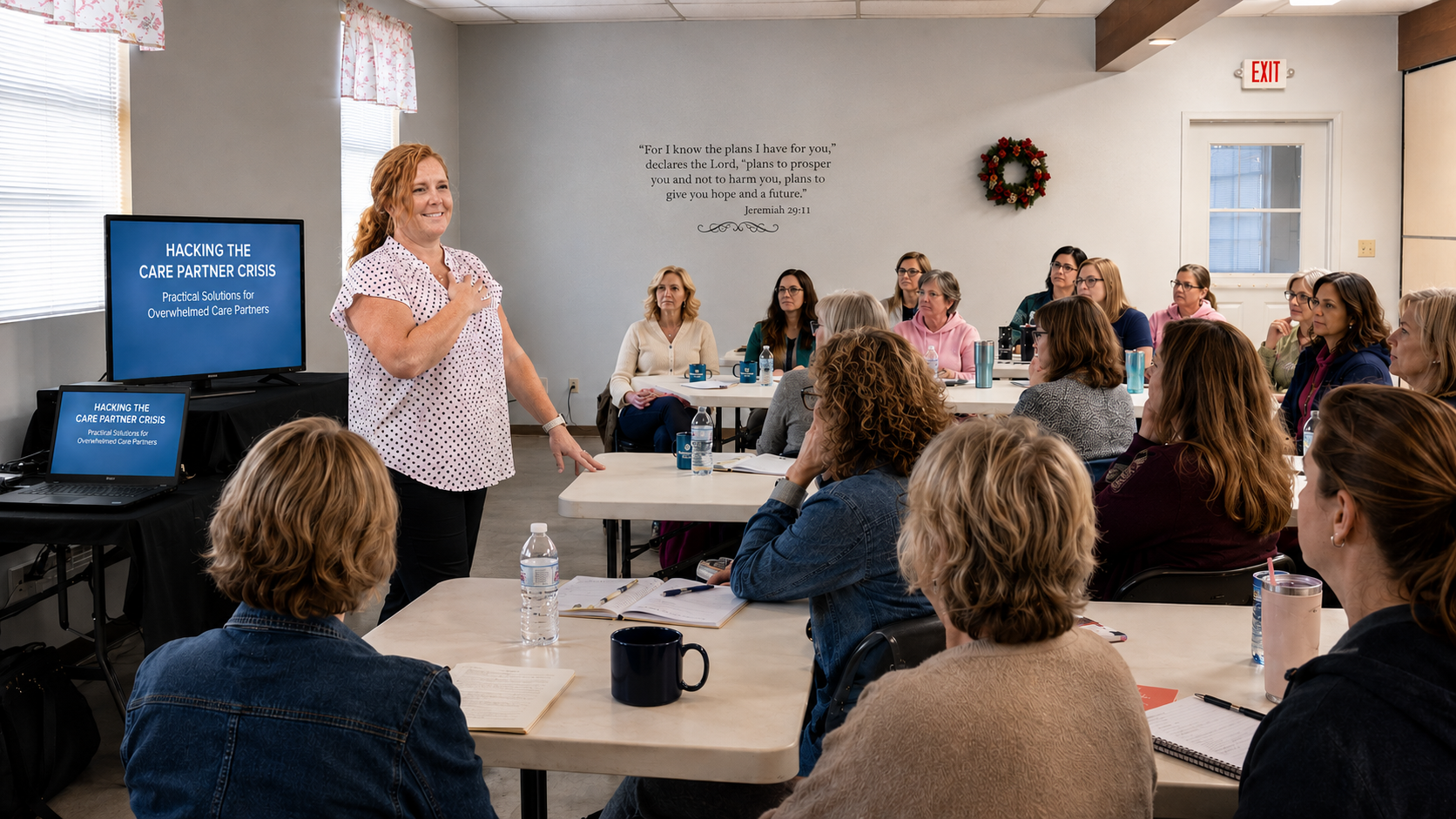
I was presenting Hacking the Care Partner Crisis to a room full of women. Women who, statistically speaking, are far more likely to become the primary care partner for an aging parent.
From the moment I started, I felt…off. Actually, that’s putting it kindly. I felt like a fish out of water.
To make matters worse, I had forgotten my printed speaker notes. Instead of looking at the audience, I found myself glancing back and forth between my laptop screen and the notes tucked away on the right side of my presentation.
If you’ve ever spoken to a group, you know how much harder it is to stay connected when your eyes keep drifting back to a screen.
Then there was the time of day. 3:30 in the afternoon. Let’s just agree right now that this is a terrible time to present. It’s the bewitching hour. It’s snack time. Nap time. “I’ve already had three meetings today” time.
Throw in a gloomy, rainy afternoon, and I was convinced I was losing them.
I finished the presentation thinking: “Well…that wasn’t my best work.” Then something happened.
One Question Changed the Entire Afternoon
One woman raised her hand.
“What do you recommend if your parents don’t agree on anything…and one of them doesn’t want to share anything at all?”
Instead of answering from the front of the room, I pulled up a chair and sat down beside her.
The room disappeared. It was just the two of us having a conversation.
I told her I might start something like this: “Hey Mom… If something happened to me tomorrow, I would want you to know what mattered to me. It made me realize…I don’t actually know what matters most to you.”
Then I’d stop talking. I’d let her answer. I’d share a little more. She’d share a little more. This is not an interrogation.
I wouldn’t pull out a checklist and start working my way down it.
Where are your legal documents?
What do you want if you can’t live here anymore?
Who’s making your medical decisions?
What about your finances?
Imagine someone walking into your living room and doing that to you. How much would you want to share? Probably not much.
Because these conversations aren’t really about collecting information. They’re about trust.
Talking to aging parents about the future works better when the goal is connection first and information second.
Talking to Aging Parents Means Remembering They’re Still Your Parents
What almost never works is walking into your parents’ home announcing that you’ve done the research, know what’s best, and they’re going to listen because you’re the educated one.
Nobody enjoys being parented by their child. Especially your parents.
As much as possible, they still need you to be their son or daughter. Respectfully curious. Not authoritative. That’s one of the most important things to remember when talking to aging parents about what comes next.
That doesn’t mean you ignore something important because the conversation is uncomfortable. It means recognizing that how you approach the conversation can determine whether there is another conversation after this one.
Ask one question, listen to the answer, let the conversation go somewhere you didn’t expect, and sometimes, know when to stop.
You don’t have to accomplish everything in one afternoon.
This Is Where Perseverance Belongs
Oh, and if you haven’t read my blog about perseverance… This is exactly where perseverance belongs.
I’ve written about it a couple of times, and here it is again—in a completely different setting than we typically think about.
Most people would probably think about patience here. That’s a good one. It belongs here too.
But perseverance is now sitting in your parents’ living room. Because talking to aging parents may take more than one conversation.
If the first conversation doesn’t go well… Try again.
When Dad changes the subject… Try again.
Or Mom says, “We’ll talk about that another time…” Respect it. Then try again another day.
There could be several reasons for procrastination. Maybe your approach needs to change, maybe the timing was wrong, maybe you asked too many questions, or maybe you started with the hardest conversation instead of the easiest one.
A conversation that doesn’t go well isn’t necessarily a closed door. Sometimes it just means you need to knock differently next time.
Families Rarely Get to Prepare in a Straight Line
One of the first things I teach families is that there are stages we naturally move through as we begin preparing for what comes next.
In The Prepared Family, I walk through six stages, beginning with simply recognizing that change is happening and ending with a family that has clarity about wishes, roles, plans, and next steps.
In a perfect world, families would move through those stages slowly. They’d have conversations over coffee, update paperwork before it became urgent, answer questions while everyone still had the luxury of answering them without pressure.
Unfortunately… That’s rarely how it happens.
More often, families skip five stages overnight because an ambulance just pulled into the driveway. Suddenly they’re making decisions they never imagined making—or decisions they’ve been dreading and avoiding—with information they wish they had gathered years earlier.
Someone is trying to remember the medications, someone is calling a sibling, someone is searching for paperwork, someone is asking Mom a question she may no longer be able to answer clearly, and everybody is trying to make a good decision while the clock is running.
I’ve sat with those families and helped them pick up the pieces.
We’ll get through it. We always do. But I would much rather help you avoid that version of the story altogether.
Talking to Aging Parents Doesn’t Have to Happen All at Once
Start now. Not because a crisis is waiting around the corner. But because none of us gets to choose when the corner appears.
Start with one conversation. One question.
When you’re talking to aging parents about the future, start with one conversation. Maybe something easy.
Ask Dad what matters most to him if he ever needs help at home. Ask Mom who she would want involved if a medical decision had to be made. Lastly, ask where one important document is kept. Then listen.
You don’t need to walk away with every answer. You just need to open the door.
And if the first conversation doesn’t go well… Take a breath. Adjust your approach. Remember you’re talking to your parent, not your patient.
Then… Try again.
Keep These Conversations Going
Preparing for what comes next with an aging parent doesn’t happen in one conversation—and you shouldn’t have to figure it all out on your own.
That’s why I created the Save Our Sanity Society Monthly Newsletter.
Each month, I share real stories, practical guidance, resources, and lessons from nearly 30 years of working with older adults and their families—all designed to help you become more prepared before a crisis forces your hand.
Choose whichever version works best for you.
Get the Digital Edition: Have the free monthly newsletter delivered directly to your inbox.
SEND ME THE DIGITAL NEWSLETTER
Get the Printed Edition: Prefer something you can hold onto, highlight, or share with your family? We’ll mail the free printed edition directly to you.
MAIL ME THE PRINTED NEWSLETTER
Both editions are free. Choose whichever works best for you.
Stay Connected Beyond the Blog
If you’d like more practical guidance, real-life stories, resources, and reminders that help you feel a little more prepared for what comes next, come connect with us on Facebook.
Follow HolistiCare Homes for resources and practical support for families and care partners.
FOLLOW HOLISTICARE HOMES ON FACEBOOK
And follow Shelley Pillado for more of my personal perspective, lessons from nearly 30 years of working with older adults and their families, and the things I’m learning along the way.
You don’t have to figure all of this out in one conversation. Let’s keep learning together.
Your partner in care,
Shelley