
I did not do well in speech class. I earned a solid C. Not a “hidden potential” C. Just a very honest C. Public speaking made my brain evacuate and my mouth dry up. If you’d told me then that speaking — especially about care partner education — would become one of my favorite parts of my work, I would have laughed politely and changed the subject.
The nervousness never fully went away.
Instead, it just changed.
There’s a difference between being nervous because you’re forced to talk about something you don’t care about and being nervous because you deeply care about what you’re saying.
And somewhere along the way, I discovered I had a lot I cared about saying.
Then Someone Bought Me Two Suits
About three years into my occupational therapy career, a boss decided I needed to be trained as a speaker and educator.
She bought me two suits. Actual suits.
Her theory seemed to be that if I looked like a speaker, I’d become one. And somehow, she was right. Not because the suits magically made me more confident. They didn’t.
But the opportunity showed me that I didn’t actually hate standing in front of a room.
I hated feeling like I had nothing meaningful to give the room.
Once I was teaching something I understood, something I had seen play out with real people, something I knew could make someone’s job or life easier, everything changed. I fell in love with educating. Not performing.
Teaching.
Taking something complicated and making it understandable. Taking something clinical and connecting it to what actually happens at 7:30 on a Tuesday morning when someone won’t get dressed, won’t take their medication, or insists they absolutely do not need your help.
That felt useful. And useful has always mattered more to me than impressive.
Then My Education Changed
Early in my career, I taught from what I knew as an occupational therapist and that gave me an incredible foundation and shaped the way I approached care partner education from the very beginning.
For decades, I’ve watched how aging, illness, injury, dementia, neurological changes, environment, habits, relationships, and expectations affect a person’s ability to function. I’ve helped people relearn skills.
At the same time, families have looked to me to help them understand why something that used to be easy suddenly wasn’t.
I’ve watched body language, movement patterns, problem-solving, transfers, reactions, frustration, fear, and the thousand little things that tell you much more than a diagnosis written on a piece of paper.
But eventually, my education changed because my seat changed. I wasn’t only the occupational therapist anymore.
I became a care partner.
Suddenly, I was the person responsible for figuring things out when the professional wasn’t standing in the room.
Then, I became the owner of an assisted living home.
I wasn’t simply helping someone during an evaluation or treatment session. I was seeing what happened at breakfast. At bedtime. During medication changes. After a difficult family visit. On good days, bad days, and the days when absolutely nothing went according to plan.
And through HolistiCare Homes, I’ve had the privilege of seeing care from yet another perspective: the families trying desperately to make good decisions for someone they love.
Every one of those roles changed the way I teach.
The Same Information Doesn’t Work for Every Room
Over the years, I’ve spoken to very different audiences. I’ve taught professionals who work with older adults and I’ve taught people who support families.
Some of those rooms have been filled with care partners who are in the thick of it every single day.
I’ve taught families who are just beginning to realize that Mom or Dad may need more help.
The topics have been just as varied: dementia and brain change, typical versus atypical aging, communication, resistance, expectations, what someone may still be capable of, and how the way we approach a situation can sometimes change what happens next.
And I’ve learned something: You cannot walk into every room and teach the same way.
For example, a professional may want to understand what’s happening neurologically.
A daughter may be thinking, Okay, but what do I do when Mom refuses to shower?
A spouse may be wondering why the person they’ve loved for 50 years suddenly seems angry with them.
A care partner may simply need someone to explain that the behavior they’re seeing isn’t necessarily personal.
And a family who has just begun noticing changes may not even know what questions they should be asking yet.
That’s the part of presenting I love. I get to meet people where they are and connect the information to real life.
Why Care Partner Education Matters
Care partners are often navigating enormous responsibility with very little guidance.
They’re expected to notice changes, coordinate appointments, manage medications, communicate with providers, make decisions, keep someone safe, navigate family dynamics, figure out finances, research care options, and also somehow know what to do next.
That’s why care partner education has to go beyond simply giving people more information.
Information isn’t helpful simply because it’s accurate. It has to be understandable, and has to connect to what’s actually happening at home. Most importantly, someone has to be able to use it.
That’s what I want people to leave my presentations with. Not a notebook full of terminology.
I want them to leave thinking:
Oh. That’s what I’ve been seeing.
That’s why that keeps happening.
Maybe I could try approaching it differently.
I didn’t realize that was something I should be paying attention to.
Okay. I know what question to ask now.
Sometimes understanding what you’re looking at changes everything.
Why I Keep Getting Back in Front of the Room
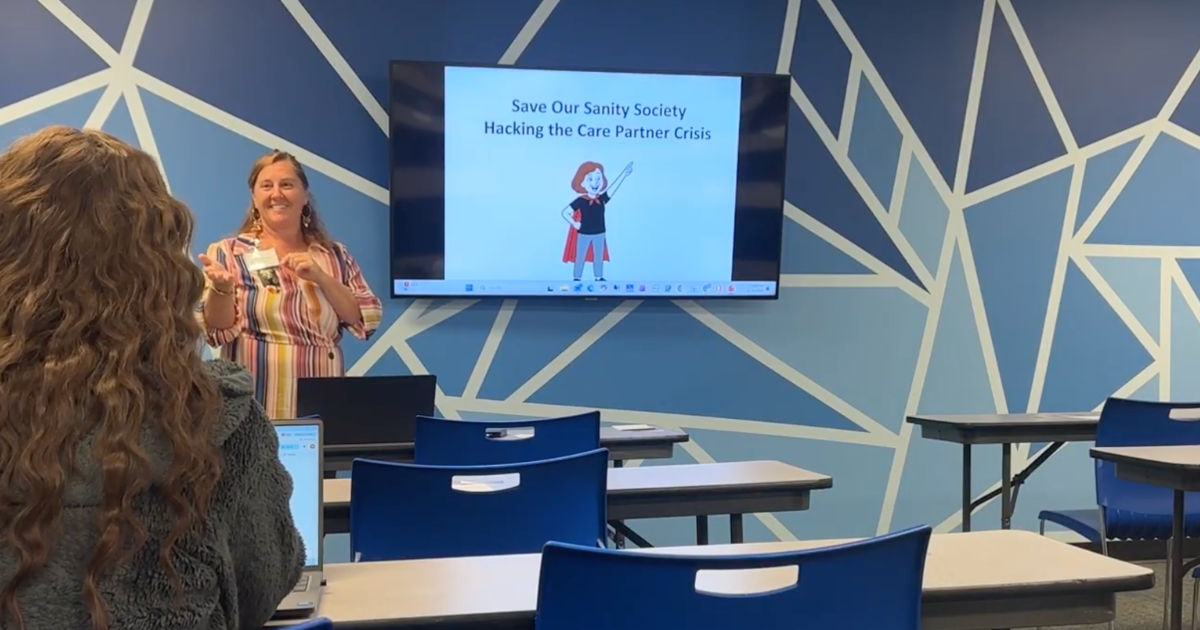
That’s why one of my goals for 2026 was to get back out into the community teaching and presenting. And I’ve been doing it.
I’ve had opportunities to stand in front of different groups again, teach workshops, answer questions, hear people’s stories, and talk about the things I believe families, care partners, and professionals deserve to understand.
Every room is different, and every audience asks different questions. Almost every time, someone says something afterward that reminds me why I keep doing it. They tell me about their mom, their husband, a resident, a client, or something that’s been happening at home or at work that suddenly makes a little more sense.
That’s the moment I care about.
Not whether I gave a flawless presentation or every slide transitioned perfectly. I want to know whether someone walked out understanding something they didn’t understand when they walked in.
Did something become a little less scary? Did they leave with something they can actually use?
The nerves are still there when I speak, but I don’t think that’s necessarily a bad thing anymore.
Now, they come from knowing the person sitting in the third row might be exhausted, scared, or quietly wondering whether what they’re seeing in someone they care for is normal.
The message matters because the people in the room matter. That still makes me nervous. I’m okay with that.
Also, speaking to a room full of care partners is still far less intimidating than trying to explain dementia in 30 seconds at a family holiday dinner.
Some things even two suits can’t prepare you for.
I Guess My Speech Teacher Would Be Surprised
If you had shown that C-student version of me what I’d eventually be doing, I’m not sure she would have believed you. But maybe that’s because I thought public speaking was about being a good speaker.
I don’t anymore. For me, it’s about having something worth teaching and knowing why you need to teach it.
Care partner education gives me a way to take what I’ve learned over decades and put it into the hands of people who can actually use it. I’ve spent those decades learning from older adults, patients, residents, families, care partners, professionals, and my own experiences.
I don’t want all of that knowledge to stay in my head. I want to translate it and make the complicated things easier to understand.
That means helping care partners recognize what’s happening before they’re drowning in it.
I want families to know there may be options they haven’t considered, professionals to see the person underneath the behavior, and people to walk out of a room feeling a little more capable than when they walked in.
Care partners already do hard things every day.
That’s why my job is to make understanding aging and care one of the lighter loads.
That isn’t a career move. It’s a commitment.
Want to See What I Mean?
One of the things I love most about teaching is helping people look at something familiar in a completely different way.
That’s exactly what happened to me when I finally completed Positive Approach to Care training. It changed the way I thought about dementia, behavior, communication — and even some of the skills I’d already been using for years without realizing it.
In “You’re Looking Right At It… And Still Not Seeing It,” I share the realization that stopped me in my tracks and why understanding dementia behaviors may have less to do with learning the perfect technique and more to do with learning how to see the person differently.
Read “You’re Looking Right At It… And Still Not Seeing It” Here
Take One of My Favorite Resources With You
When I teach, I don’t want people to leave with good intentions and a page full of notes they’ll never look at again. I want them to leave with something they can actually use.
That’s why one of the resources I regularly share and recommend is my Prepared Daughter Survival Kit.
It was created for the daughter — or family care partner — who is trying to stay one step ahead while juggling questions, decisions, appointments, changing needs, and all the little details that come with helping an aging parent.
Consider it one more way I can send you home with something practical, even if you weren’t sitting in the room with me.
Get the Prepared Daughter Survival Kit
Your partner in care,
Shelley